Degu Information
Introduction
In short, a degu is a small mammal native to Chile. They are a rodent that is related to chinchillas and guinea pigs.
Despite people having kept them as pets for some time, a lot people still have never even heard of degus or even if they have, know little about them. One contributing factor (in my opinion) is the lack of accurate and amount of contradictory information on them. In the past, there didn't even seem to be agreement about what a degu was. I remember hearing people call degus Australian rats or gerbils and south American squirrels to use some examples.
While the advent of the more public Internet and World Wide Web did over time help to provide information about degus, a lot of that information tended
to be contradictory. While people did have good intentions, there was also a lot of advice that was inaccurate or even outright harmful to degus.
If people were offering inaccurate or harmful advice, they often didn't realize it.
One reason for this as the difficulty in finding books that had anything more then a simple article or two about degus. An additional
lack of professional advice only worsened the problem.
It's similar to how many different ideas and information that are out there as to the best diet and lifestyle we should adopt if we wish to do what's best for our own health. Everyone seems to have a different idea. While people may have good intentions, it can difficult to decide what advice to follow.
While these issues with degu care are not as serious now, they do still exist.
This is a issue as when someone sees degus in a store, it's easy find them cute and otherwise appealing. The decision to get one or more will seem to be easy. As with any pet, it's important to do research before adopting a species you're unfamiliar with to see if said species is one that would make a good pet for you and if you will be able to provide the proper care they need and deserve.
The goal of this section is to provide at least some of what I hope is accurate information in order to help people care for their degus.
How long they live
Like many small mammals and rodents in the wild degus are the target of many predators. They are also victim to many diseases and pesticides from farms etc. As a result of this in the wild most degus do not live very long at all. Of all degus that are born and live in the wild only 50% survive until their first birthday and only 1% live to see their second birthday. The absolute maximum life span in the wild appears to be about 3 to 4 years. In captivity this is greater as they do have access to better food and do not get as much disease and there are no predators. It would appear that the average life span for a captive degu is anywhere from 5 - 9 years. The reason there is such a gap is because many factors such as diet, number of pregnancies in females, and health play a major factor in the number. It is important to remember that while they can live to be 9, a 9 year old degu is like a 120 year old human ; it's possible but extremely rare. A 5 year old degu is starting to get old. Diet appears to be the leading factor in their longevity, a recommended diet is listed below in the diet section.
Appearance
It is difficult to describe what a degu looks like without making reference to another animal. In the case of degu's what animal they look like depends on your point of view. To most people degu's look like gigantic gerbils and yet to others they look like squirrels. It is true that they are similar in shape and proportions to the gerbil but their face looks like that of a squirrel or a chinchilla. Actually in a way a degu is a small chinchilla, only with less fur and brown fur and smaller. As of now all degus have brown fur on the top with black mixed in to make it about 60% brown, 40% black. Some degus are lighter and others are darker. Generally the more black fur they have the darker they are and the more brown fur they have the lighter they are. Their chests are a light brown colour and their feet which each have 5 toes are a nice gray-white colour. Their tails are like a rats, but shorter in proportion and with a small amount of fur and a tuft of fur at the tip of it. I have not heard of any cases of colour mutations in degus as of yet. Their teeth are normally a very bright orange colour, this is normal for both degus and chinchillas and is usually a sign of good health. The reason their teeth are orange, is that the chlorophyll in the greens that they eat reacts with an enzyme in their bodies and produces an orange organic fluid in their saliva. You will notice that when they walk the hold their tails partially up, possibly to keep it from wear or damage or even getting caught.
How big (or small) are degus is mostly a matter of your point of view. As with their appearance it is difficult to describe their size with out making a comparison to another animal. According to the rodent section of the book of mammals, degus have similar proportions and body size to that of the rat. In fact degus are slightly smaller than rats in body length. Degus are much more chubby and round (not fat) than rats are. A degus tail, provided it has not lost the tail as discussed in behaviour is usually about 1/2 to 2/3 the length of their body. Generally; rounder (or fatter depending on your point of view) degus have longer tails proportionally to their bodies and skinnier degus have shorter tails as a proportion of their bodies. If your looking for numbers then normally A full grown adult is about 6" long with another 6" in tail with a bit of fluff on the end of the tail.
Behaviour
Degu behaviour is very fascinating. They are intensely hyper sometimes and very tranquil at others. To some it may appear that they never sleep because they always seem to be on the go or ready to leap. They do sleep at night but have short sleep cycles which means that when they do fall asleep they wake up again only about 20 minutes later. While they will get a full nights sleep each night they tend to do it in lots of little bits. Humans also do this but our sleep cycles are much longer.
They love to run around, climb and getting into dark, warm places.
Degus are very social with both people and each other. However, it's important to remember that nothing can replace the companionship of another degu. There are degus that will not get along with other degus no matter what. However, it's always best for them that they have at least one companion.
In most cases two male degus will not get along together and will fight. However there are some cases where two males may get along. If two males that are brothers who have been together since birth are kept in the same cage and there are no females within smelling distance then they should get along. Two males from separate litters may also get along also if no females can be seen or smelled etc. However if you do put two males in the same cage and they do fight then separate them as they will fight to the death in almost all cases if they are not stopped.
If a degu sees a person it recognizes it may react with a variety of sounds depending on it's mood. Don't be surprised if a degu jumps out of it's cage when it wants out.
When you have degu's out it is important to keep a close watch on them at all times. They are very curious and are always exploring their environment. They can run very fast and because of their size it is easy for them to get away and get into things. Degus will chew anything and everything, including wires! Because of this it can dangerous to allow a degu run free out of it's cage unless it's in a degu proof room. Other sites have good guides as to how to degu proof a room. I recommend consulting them before getting degus.
When you pick them up it is best to let them step into your hand rather then simply grabbing them, grabbing can result in frightening them and they might bite.
Never pick a degu up by the tail or grab the tail, degus have the ability to drop their tails like a lizard if it is grabbed and unlike a lizards tail it doesn't grow back.
Sounds they make
Degus have a wide variety of sounds that they make to one another depending on their mood. If they are in a good mood then they will usually make a warbling sound that sounds allot like a bunch of short high pitched squeaks together at a very fast rate. This sound usually indicates that the degu likes whomever it is making the sound at, whether it be a person or another degu. A male degu will almost always make this sound to a female degu that he wants to mate with when he sees her. If you would like to hear these sounds then go to the sounds page. Another sound that they make is the popular chattering sound. This sound means basically the same thing that it means when a guinea pig or squirrel chatters. A chattering degu is an unhappy degu. They will usually only chatter when they are being teased or if a male sees another male. This sound sounds like a fast version of the sound you get when you tap your top teeth against your bottom teeth. The third sound that degu's make is a loud squeak like a mouse, rat or squirrel. If they make this sound it usually means that they are very upset or annoyed about something. They will often make this sound to wards another degu if they simply do not want to see that degu. They can also make this sound to wards a person if they are doing something and are suddenly grabbed or startled. And finally they may also make this sound if they are grabbed in an unpleasant way. If your degu makes this sound as you go to pick it up do not continue to pick it up in this fashion. A degu that is making this sound to a person as that person is going to pick it up is saying that "I do not want to be handled in that fashion and if you continue to do this to me I will bite you in self defence". The best way to pick up a degu is to let it crawl into you open hand then to gently lift it up in a secure manor. When two degus are making this sound to each other separate them immediately or they will fight.
Diet
It is important to be careful of what you feed your degus. A degu will eat just about anything you give it. This is one of the aspects of degu care where there is a lot of disagreement on what is right and wrong for them. While this can be frustrating, remember that even for us, there is a lot of disagreement as to what we should and shouldn't eat and what quantities are acceptable or not.
I do try to provide as accurate information as I can. Bear in mind however that it's best to consult multiple resources and that much like with information as our own food needs, what we know of degu's needs is something that changes often.
One resource to consult is http://forum.degus-international-community.org//. They have a forum where you can ask various members their opinions about what diet is best.
Degus cannot metabolise simple sugar such as is found in fruit, and they will develop diabetes and cataracts if fed sugary fruits and vegetables.
The traditional small animal food has corn and sunflower seeds, which can be anything from simply not good for them to outright bad for them because of the oil and in the case of the sunflower seeds, the fat as well. As such, it's best to avoid it.
Degus love raw peanuts, but the fat collects in their livers, and is harmful - particularly to pregnant females.
Carrots have a lot of sugar and are something you should avoid. The why the yellow vegetable of choice should be Sweet potato (yam is similar but lower in vitamins).
In laboratories, degus are fed rat chow (also called lab blocks or rat blocks) and they do well, but you can be sure that they are not all that happy eating it.
Degus should have a yellow vegetable (sweet potato), a green vegetable (dandelion is loved by them but beware of pesticides), but any very green leaf vegetable, preferably not from the cabbage family is O.K. Don't cook the sweet potatoes , give them to them raw. Also make sure to remove the skins and roots, as I have read that these are toxic to degus.
Here is a list of vegetables in the cabbage family as provided by Amanda Rose
Beet greens Horseradish
Bok Choy Kale
Broccoli Kohlrabi
Brussels Mustard Greens
Sprouts Radishes
Cabbage Rutabaga
Cauliflower Swiss Chard
Chinese Cabbage Turnips
Collard Greens Turnip Greens
Garden Cress
Guinea pig pellets are good. They are rich in vitamin C and will keep your degu's teeth and gums healthy. Chinchilla pellets are good. Some feed their degus a mix of the two. Just avoid the aforementioned small animal food that has the sunflower seeds and corn.
They should also have some form of hay. Timothy hay is best. Alfalfa has too much calcium. However, there is some debate on this.
Food dishes should be cleaned weekly, with hot water.
Sexing degus
Male Degus have inter abdominal testes, so there is no scrotum that immediately distinguishes the male from the female. The most distinguishing characteristic is the spacing between the urethra and the anus. In the female, the urethra and anus are very close together, while in the male a bit of space can be seen between these openings. In mature animals, the male urethra takes on more of a penile shape, while the female urethra is more conical.
Breeding
Before you consider breeding your degus, it's important to remember that it can be very difficult to find new homes for the babies. It's probably best to avoid breeding them and leave it to the professionals. If you do want to breed them however, it's best to consult professional resources on the subject. As well asking on forums such as http://forum.degus-international-community.org// or on mailing lists such as Degu Mail.
Because it can be difficult to tell the difference between a make and female degus, it is possible that you might find yourself with a pregnant female when you thought you were getting two or more of the same gender.
Degus become sexually mature between 45 days and one year depending upon climate and other factors. Six months is average. Pregnant females are fairly easy to spot about after a few weeks and they get very round and clumsy towards their due date. However, as with all animals, it's important to remember that more then one degu owners has awoken one morning to find several new and unexpected additions to their degu family. The gestation period for Degus is 90 days, and litter size varies from one to eight, five being average. Female degus have 4 pairs of teats.
It is best to go easy on your female while she is pregnant to avoid complications. A female degu is very fragile and can abort quite easily.
Like many small animals, female degus can become pregnant immediately after giving birth. Because of this, you need to separate the male from the female for the first few days of the babies lives. She can become pregnant again a few weeks after however, so it's important to be aware of this. Having babies is hard on a female degu. As such, it's best that you don't breed them more then once a year.
The male will assist in caring for and playing with the babies once it's safe for him to be back with the female. In some rare circumstances he may attack them, if that happens he needs to be separated from them and her.
Baby degus are born well developed. They usually have a full coat of fur and maybe even open eyes at birth. The female will nurse them by lying on top of them.
It is best to remove the wheel from the cage because sometimes she starts running on it at the same time a young one stands on it, the poor thing goes flying and can get hurt.
The babies develop quickly and are usually eating solid food and drinking water within a couple of weeks. It is best though for them to stay with their mom for at least 6 weeks, just in case. When baby degus are about a week old it is okay to handle them. Before you handle them though, make sure that their mother is fully familiar with your "scent". Getting her familiar does not seem to be to difficult, all you need to do is get her out. If you do get her out during pregnancy as with any animal, take extreme caution and do not "rub" her belly as this can from what I have heard cause a miscarriage. Baby degus seem to enjoy being gently patted and like crawling around people, again as with any infant animal take all necessary precautions and don't take any risks. hand raised baby degus make excellent pets as they lose all fear of humans and will enjoy being out.
Introducing new companions
Degus are social animals that interact with each other in a multitude of ways. It's important that your degu has at least one companion. While some degus will not get along with other degus, if at all possible, make sure they are not alone as nothing can replace the companionship another degu can offer.
Keep in mind however that degus like other animals do have a sense of territory. If you want to introduce a new degu to a degu that you already have it is important to try to do it at as young an age (degus age) as possible. The best way to introduce a new degu is to first let them sniff each other while you hold both of them, if they react by chattering then that is not totally a problem because they are just simply saying that this is a strange degu and see it as an intruder. At this point you must get them used to each other. Always make sure that you have a backup cage that can become one of their homes should they decide that they do not like each other. If it is at all possible place then in the same cage with a divider halfway between so that one is on one side and the other is on the other side. Make the divider one that is non toxic, non chewable and allows them to see and smell each other. Both sides must have food and water access and wheel access so it is important that this takes place in a relatively large cage. After about a week the degus should be getting used to each other and you can remove the divider. If space permits keep both wheels and food dishes and water bottles in so they will not start to fight over them. If they start to fight for no reason and will not stop then separate them and put one in the backup cage, this is a pairing that just will not work. If you want to try to put a degu in with a rabbit or a guinea pig then follow the same rules as above except keep the divider in for at least a couple of weeks as to allow each of them to become accustomed to a new species. And as always make sure to give the original animal lots of attention, especially when giving the other animal attention. Like human babies and children and dogs and cats they can quickly get a sense of abandonment if you only give the new one attention.
What Should they be kept in?
Degus are very active animals that and the size of their cage should reflect this.
First and foremost, an aquarium is far too small for a degu.
Bear in mind that the more degus you have in a cage, the larger the cage needs to be. Degus are social animals and need companionship. As such a large cage is a must.
The cage should not only be large but have several different levels with ramps separating them. It's best for it to be made of wire mesh for optimal ventilation. Make sure that the cage has a solid bottom. Cages with mesh bottoms and rodents do not mix and can actually be harmful to them. This also applies to the ramps leading to other levels as well as the shelves.
Below are four examples of cages. Click each link to see a full sized image. The first one you click will open in a new Window or Tab depending on your browser settings. The rest of the cage pics will then open in that Window or Tab.


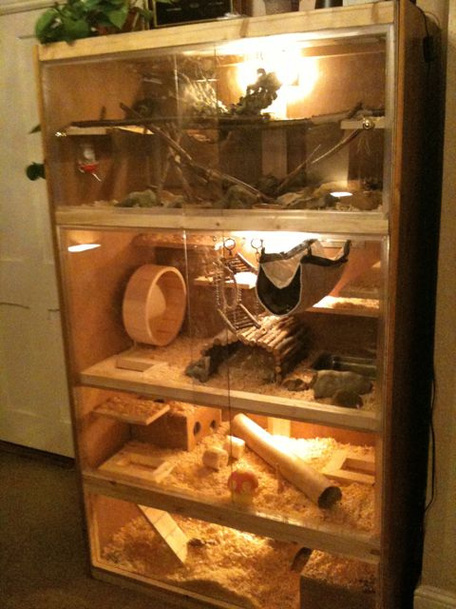
They also need a wheel to run in. The wheel should be large. Inches wise, 12 inches across is an absolute minimum. Any smaller is too small and can be bad for their backs. The wheel needs to be made of metal and needs to have a solid running space. The wheels that have the spaces on the running space are harmful to them because their toes and tails can get stuck in them.
Although it may seem harsh, if you don't have the space and/or cannot afford a large cage and wheel then degus are probably not the pet for you. I know that sounds harsh but it's important to think of the welfare of the degus and to do what best for them.
Much like hamsters, they cannot have a water dish as it will get very messy. A water bottle is a great substitution. Just make sure that if you use a water bottle to check it every day to make sure that they are able to get the water out of it. If the water level is going down and it is not leaking by itself then that is a good indication. It is a good idea to rinse and change the water every days to keep the water fresh. Don't expect a degu to drink something that you would not.
For the bedding, a single layer is enough. Carefresh, recycled paper and kiln dried pine are fine. Aspen is preferable. If it must be a softwood then only use kiln dried pine. Ceader is unacceptable as it has oils which are bad for degus and other rodents lungs.
Degus are most comfortable in temperatures of 65 - 75 degrees Fahrenheit or around 20 Celsius. Beyond that temperature range they will be uncomfortable. At 25 Celsius (85 Fahrenheit) they will be laying on their stomachs to try to minimize activity to keep cool. They cannot sweat to keep cool. Anything below 20 Celsius (60 Fahrenheit) is very cold for them. Baby degus should be kept at no colder then 70 Fahrenheit which is cold for them.
They benefit from having a small wooden nest box. 6" wide by 8" long by 6" high with two openings is ideal for two or three Degus. Put a handful of Timothy hay in it once a week, and then give them a few paper towels to tear up and carry into the nest box. A 12" wheel is must for them to get their exercise. Some male Degus keep "trinket piles" of rocks, stones, wood pieces, old keys - anything shiny, but never plastic. Their trinket pile is their status symbol. They sometimes become annoyed if someone disturbs their trinket pile (although this is necessary for cleaning). Many domestic male Degus have lost this instinct, however.
Like chinchillas, Degus need a "dust bath" to maintain the health of their fur and skin. Provide a "bathtub" with about 1/2" of chinchilla dust for half an hour once or twice a week. Don't leave it in the cage too long, or your Degus will use it as a potty stop. Replace the dust after several uses. Don't use a plastic one as they will chew the plastic.
When and how to clean their cage
Degus are normally like rats and other rodents very clean animals. Despite this however they must have their cage cleaned on a regular basis in the same way that we must have our homes, buildings and streets cleaned regularly. Hygiene is as important for a degu as it is for any other animal. You should clean their cage out at least once a week but that changes depending on the size of the cage. If your degu is in a small cage it needs to be cleaned more often and if there are multiple degus in a cage it goes the same way. Generally for a cage that is about the size that was discussed above with 1 degu in it you need to clean it about once every 7-10 days depending on how clean the degu is. For every extra degu you add clean the cage twice as often; similarly for every 50% decrease in cage size from above also clean it twice as often. The actual cleaning of the cage can be difficult simply because of it's size and possibly it's shape. It is best to use water to get out all traces of the old wood chips and to get and urine smell out (like with a gerbil rat or hamster which a degu is about = to in level of urine). Do not use any chemicals or soaps that may be poisonous or other wise allergic reaction forming to degus. Just using water and if applicable a good scrubber (like a shower one not an SOS pad) is enough. Actually you don't need to fully water the cage down each time, only if the smell is really bad or if it's been to long since the last clean. If you can get the litter out completely without water and there is no smell (which is normal) you should be okay. It is best however to water it down totally once every couple of months even if it doesn't seem needed to remove germs etc. (After all the cage is not only their bed and home but also their toilet)Where to put your degu during the cleaning process is important, they must be put in a safe place that they cannot get away from, personally I put them in a small circular hamster cage while I clean the cage or I let the degu sit on my shoulder. Finally an important issue is what kind of bedding to use in your degus cage, basically it is best to use what you would use for a guinea pig or hamster. Recent developments have evidence that using soft wood as wood chips can cause problems for rodents and that it is best to use hard wood when ever possible. Pine and Ceader are soft wood. Ceader is apparently the worst kind to use because of chemicals, young rats raised on it have a high mortality rate. Pine is okay but make sure it is kiln dried as this gets rid of harmful chemicals. Aspen appears to be the best. Many people use the softwood because it smells good. there are other alternatives that are okay, ask your supplier for info about those.
Precautionary Measures
Degu's really are very amazing little animals but it is very important to always know where they are. Because they are adventurous and fearless they can get into a lot of trouble. If you have a cat then you must be careful to keep the cat away from the degu. A cat sees a degu as a rat and will definitely pursue it. Degu's are fearless little creatures and will just sit there and take the cats abuse, eventually the cat will grab the degu. My cat grabbed one of my degu's but I was able to get her away from the degu before she was injured by the cat. I don't know for sure if the cat would have injured her, but It's not worth the risk of finding out. Because of this it is critical to always keep a cat and degu away from each other. If they do come into contact make sure you have control of the cat. To a cat a degu is no different from a rat and is a perfect meal or play thing. And to a degu a cat is an interesting animal that it wants to walk around and sniff etc. to find out what it is. The above listed rules also apply for degus and other small mammals. While there is a chance that they may get along with one of these animals there is also an equal chance that they will not. From what I have heard they have been known to get along with rabbits and guinea pigs. However if you do place degu among these other animals make sure you are ready to separate them should a fight begin. See introducing them to another degu or animal for more information.
What to do if they escape
Degus enjoy running around in the same way that squirrels do. It is inevitable that they will sometimes escape from you while you have them out. Unless you keep a hold on them at all times this can be difficult to prevent. If and when your degu gets away, it is important to catch it ASAP. They can chew threw almost anything and can really hurt themselves with just about anything.
Whatever you do, do not move stuff around when you do not know where the degu is.
If it does get loose catching them can be difficult.
There are two pieces of advice that others have told me. I have reproduced them below.
The first is one a member of http://forum.degus-international-community.org// mentioned to me.
The best way to catch a degu is to put a cardboard tube (the kind that can be obtained for free from a carpet dealer or carpet department of a hardware or department store) near to it. Degus love being in cardboard tubes: it makes them feel safe and away from predators. The cardboard tube should be about 6 inches to 1 foot long. Once the degu is inside, you simply cover up both ends (to prevent the degu falling out and hurting itself while you transport it) and then transport it to the safety of its cage, playpen, or degu-proof room. Another alternative is to put a baseball cap you have worn near to the degu. If you have worn it, it will smell like you and hopefully this will be attractive to the degu.
Tracy Parsons detailed a very innovative way to catch an escaped degu which is listed below
We have our pair of Degus trained to the sound of a bell.When we ring the bell they know its time to go home and usually comply.We achieved this by setting up strict controls when handling and feeding.When we first brought the degus into our home we purchased a small bell akin to the type you trim your xmas tree with, every time we fed them we rang the bell for about 30 seconds prior to placing the food in the cage, the bell is rang every time food or even the smallest treat is offered, over a period of 2 to 3 weeks they began to associate the sound of the bell with something nice to eat or play with.As food and treats is only ever given within their cage this is where they automatically return on the sound of the bell, of course a treat is waiting for them upon their return.We could within 4 weeks allow them to run free within the confines of the lounge assured in fact that they would return home upon the sound of the bell.We have successfully used this method for various different animals with each having a different sound to respond to e.g. whistles, rattles, electronic bleeps etc.We as animal lovers find that positive association works far better than trying to discipline an animal .I hope you can try this technique for yourself as it beats the heck out of chasing small animals under furniture in an attempt to re-capture them.
What kinds of things make them good pets?
Degus make excellent pets for similar reasons to others rodents but there are some things that they can do that other rodents cannot such as exhibit advanced behavioural characteristics. One of these is their ability to recognize people, sounds and even objects. If a degu sees a person that it knows as someone that gives it attention it will usually immediately run up to the side of it's cage and stand on it's hind legs practically begging to be let out. Should you not get it out then it will sometimes squeak quite loudly. When you do get it out it usually warbles with joy. If a degu sees another degu that it knows then it will react accordingly. If it knows the degu as a mate it will usually sing out in joy and warble quite loudly. If the other degu hears this it may and usually will respond in the same way. If the degu sees another degu that it does not like then it will chatter and even squeak out loudly. They eat politely with their fore paws like other rodents and will not gulp all their food down in seconds. They seem to have very good eyesight and a highly developed sense of hearing. They can recognize objects and people with great accuracy and ease. If they see a person that they know approach their cage they will react instantly in an appropriate way. When they hear a sound that they recognize such as another degu or a persons voice they will also look in that direction so see who it is. As you can see a degu is a very fun little creature that has many physical and mental traits that are very well developed.
Closing Statements
In conclusion a degu is an animal that makes an excellent pet. They have many characteristics that are very desirable in a pet. They are very cute and affectionate. They are clean and do not require a very large cage and will only bite if severely provoked. Their longer than average life span means that they will provide you with many years of entertainment and affection. they are truly a wonderful little mammal.
If you came to this page from a link and want to go into the fully negotiable framed version click >> here